Mokroe
The Brothers KaramazovMokroe is the village twenty-five versts from town where Dmitri Karamazov’s desperate pursuit of Grushenka erupts into a three-day revel, and where the news of her former lover’s arrival gathers force. The place joins two charged episodes: Dmitri’s attempt to spend himself into a triumphant escape from despair, and Grushenka’s expectation that the man from her past is near. In both, Mokroe is less a destination than a threshold, where desire is tested by what happens next.
Setting and Associations
Mokroe is identified in Dmitri’s account as a place twenty-five versts from town. He reaches it by carriage with Grushenka, carrying three thousand roubles despite describing himself as a beggar. The distance is specific, but the account makes the journey matter chiefly for the recklessness of what follows: beyond the town, Dmitri turns his money into a scene of openhanded excess.
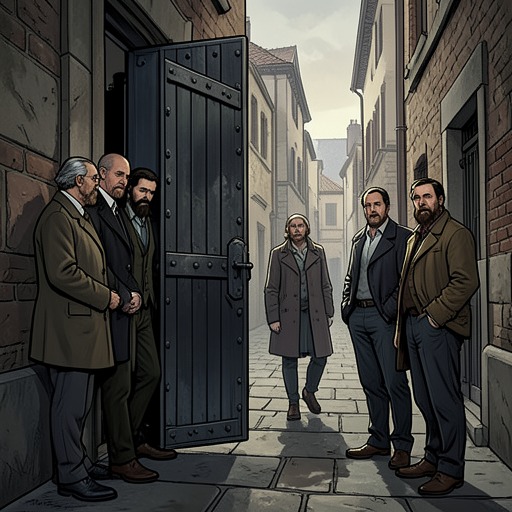
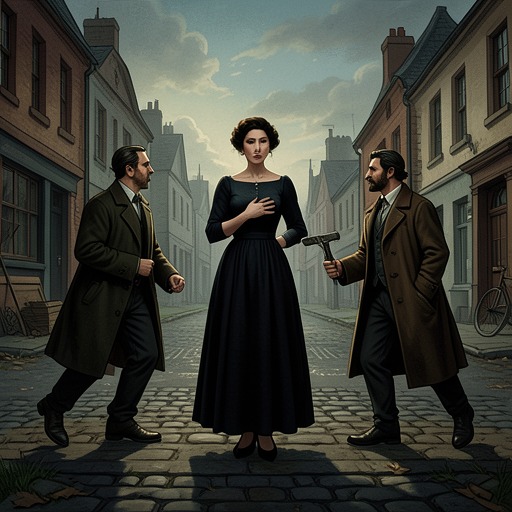
Mokroe also has a social life beyond the lovers’ private drama. During that visit Dmitri hears an old man describe a custom in which young men are assigned to thrash girls sentenced to punishment, only for a young man to ask the same girl in marriage the following day. The anecdote presents a community in which violence and courtship are made to coexist as ordinary practice. Its blunt, unsettling logic echoes the novel’s wider concern with the entanglement of cruelty, desire, and claims of affection, without making Mokroe simply a backdrop for Dmitri’s story.
Dmitri’s Three-Day Revel
Dmitri says that he arrived in Mokroe with three thousand roubles in his pocket and spent them on Gypsies and champagne, making the peasants, women, and girls drink. The money goes flying in a public performance of generosity and excess. What he calls heroism is inseparable from waste: in three days he is stripped bare, yet he insists on the image of a hero even as he acknowledges that he has not gained his end.
That contradiction gives the episode its force. Dmitri’s revel is not a successful means of obtaining what he wants; it is a brief, feverish conversion of money into noise, company, and self-dramatization. His account moves from the feeling of being struck down by a storm to the certainty that everything is over, then to the spectacle of spending without restraint. Mokroe therefore holds together defeat and bravado: Dmitri can call himself ruined and still pose as victorious, while the vanished money makes the cost of that pose concrete.
Grushenka and the Expected Arrival
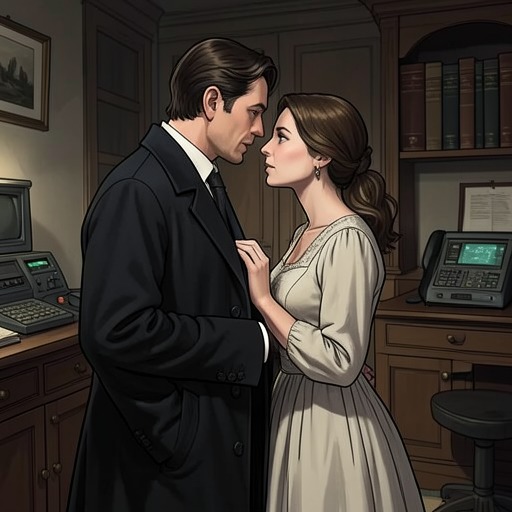
Mokroe returns in a later moment through Grushenka’s news. She tells Mikhail Rakitin that her former lover is there now and that he has written to her; she is expecting a messenger from Mokroe at any moment. The location is no longer associated only with Dmitri’s past extravagance. It becomes the point from which an anticipated arrival may reach her, making the village a live presence in the suspense of her decision.
That expectation takes physical form when a messenger arrives at the house with a carriage from Mokroe. The driver is changing horses, and he has brought a letter for Grushenka. The sequence turns distance into immediacy: first the former lover is reported to be at Mokroe, then a message and carriage carry the news onward. The arrival does not make Mokroe itself a place of resolution; instead, it makes the village the source of a summons whose consequences are unfolding elsewhere.
Narrative Significance
Mokroe gathers two kinds of exposure. In Dmitri’s recollection, it is where a fortune is scattered in three days and where his claim to heroism is measured against being left with nothing. In Grushenka’s later expectation, it is where the former lover waits and from which a messenger is sent. The place thus links Dmitri’s self-consuming display to the uncertainty that surrounds Grushenka’s past and future.
The village’s narrative importance comes from that recurrence rather than from any extended description of its landscape. It is named through movement: Dmitri drives there, spends his money there, and remembers a conversation there; later, news and a letter travel from there toward Grushenka. Mokroe is a hinge between absence and arrival, between a revel already over and a meeting still anticipated. Its episodes preserve the instability of both characters’ hopes: money cannot secure Dmitri’s desired end, and a letter from the former lover leaves Grushenka facing the possibility of a new turn.